MEXC vs Gate: Gate Lists More Small Caps, but Half of Them Barely Trade
We compared every USDT spot pair on MEXC and Gate: Gate lists 1,028 small caps against MEXC's 853, but MEXC lists new coins faster, trades 6.6 times more per small cap and has about twice the order-book depth on coins between $10M and $100M.
 CARDS
CARDS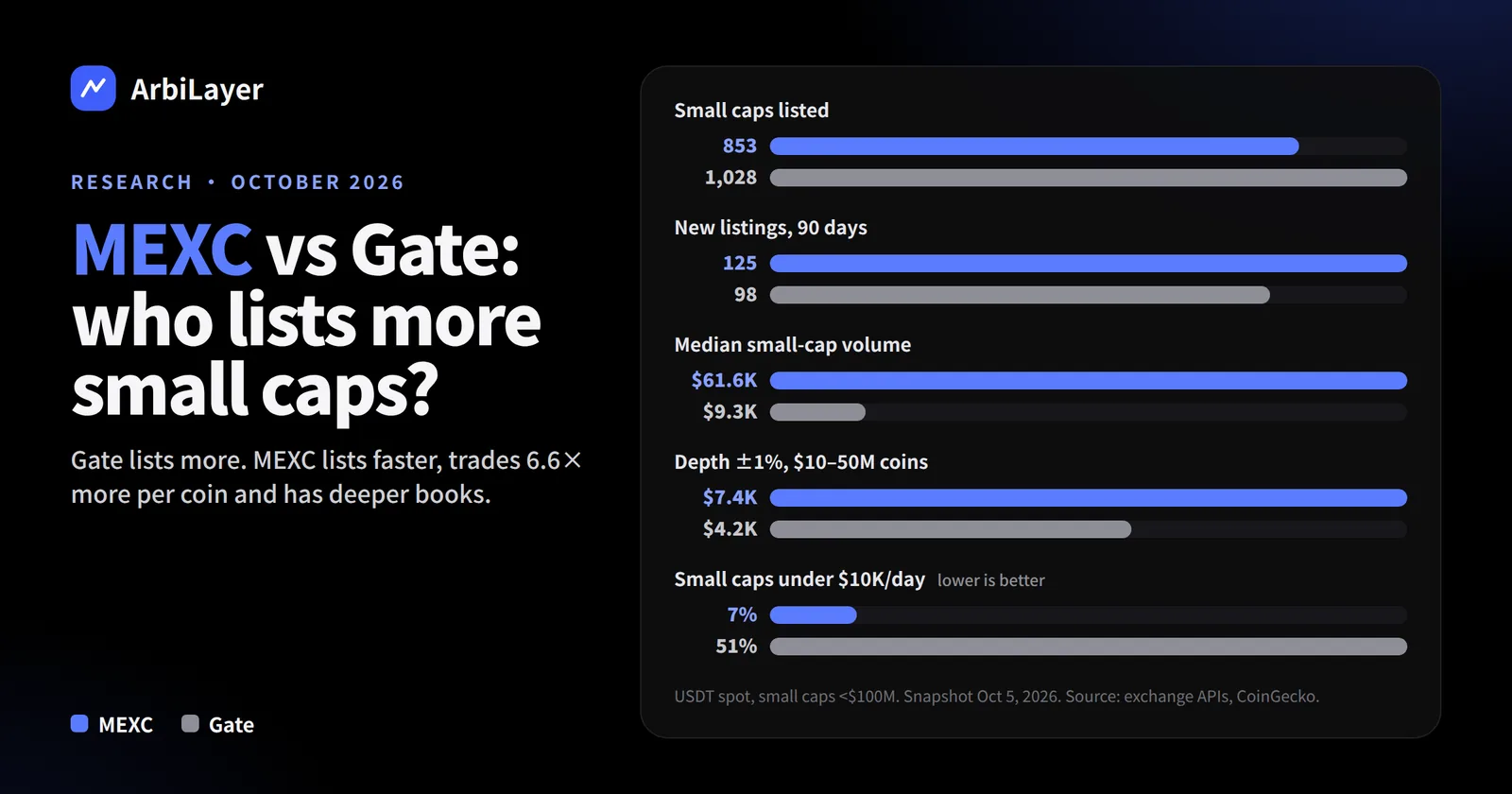
MEXC and Gate are where most traders go for coins that are not on Binance yet. Both list hundreds of tokens under $100 million in market cap, and both get called "the small-cap exchange". We pulled the full USDT spot market lists of both exchanges, matched every coin to its market cap, dated every listing and read the live order book of every small cap they share, to answer two questions: who lists more, and where can you actually trade it.
The short answer: Gate lists more small caps, but MEXC lists new ones faster and keeps far more of them trading. Half of Gate's small caps trade less than $10,000 a day.
How we measured
- Snapshot: October 5, 2026, 10:20 UTC, from the public MEXC and Gate APIs.
- Markets: every tradable USDT spot pair. Stablecoins, leveraged tokens and tokenized stocks and funds (162 on MEXC, 82 on Gate) are excluded.
- Market cap: CoinGecko market cap from the ArbiLayer database, matched by ticker and checked against the exchange price so that a different token with the same ticker is not counted. Small cap means under $100M, micro cap under $10M. Coins with no market cap or an ambiguous ticker are counted as unranked.
- Listing date: Gate's own trading start time; for MEXC, the first daily candle of the pair. A coin that was delisted and listed again counts from its latest listing on MEXC.
- Order books: one snapshot of each book. Depth is bids plus asks within ±1% and ±2% of the mid price, in USD. Slippage is the cost of a market buy of $1,000 or $5,000 against the mid price, in basis points (100 bps = 1%).
Who lists more
| MEXC | Gate | |
|---|---|---|
| USDT spot pairs | 1,239 | 1,524 |
| Small caps (<$100M) | 853 | 1,028 |
| — micro (<$10M) | 378 | 578 |
| — $10–50M | 369 | 345 |
| — $50–100M | 106 | 105 |
| Unranked tokens | 190 | 303 |
| Only on this exchange | 455 | 740 |
| — of which small caps | 293 | 468 |
| New listings, last 90 days | 125 | 98 |
| New listings per week | 9.7 | 7.6 |
Gate has the longer list. It carries 23% more USDT pairs and 175 more small caps, and the whole difference is at the bottom: Gate lists 200 more micro caps under $10M and 113 more tokens that CoinGecko does not rank at all. From $10M upwards the two exchanges are almost identical — 369 against 345 coins at $10–50M and 106 against 105 at $50–100M.
The overlap is smaller than most traders assume. The two exchanges share 784 coins. The other 740 Gate pairs — almost half of Gate's list — are not on MEXC, and 455 MEXC pairs, more than a third of its list, are not on Gate. Using only one of them means missing a large part of the other's market.
MEXC is adding coins faster right now. It opened 125 new USDT pairs in the last 90 days against Gate's 98 — about ten a week against eight — and almost all of them on both sides (96% on MEXC, 93% on Gate) were small caps or unranked tokens.
Who lists first
Only 27 coins were listed by both exchanges with at least one of the two listings inside the last 90 days, so this is a small sample, but it points one way: MEXC listed first 16 times, Gate 3 times, and 8 coins opened on the same day. When MEXC was first, its median lead was 21 days.
Some leads were much longer. Collector Crypt (CARDS) traded on MEXC from September 2025 and only reached Gate on September 29, 2026. BTW opened on MEXC in March and on Gate in late August; STONK, CASHCAT and PONS reached Gate five to seven weeks after MEXC. In the other direction, The Interfold (FOLD) opened on Gate on September 13 and on MEXC 19 days later.
The volume gap
Listing a coin and keeping it alive are different things.
| Small caps (<$100M) | MEXC | Gate |
|---|---|---|
| Median 24h volume per coin | $61,600 | $9,300 |
| Coins with less than $10K daily volume | 62 (7%) | 527 (51%) |
| Total small-cap volume, 24h | $87.7M | $55.2M |
51% of Gate's small caps traded less than $10,000 in 24 hours, against 7% on MEXC. The median small cap on MEXC turned over $61,600 — 6.6 times as much as on Gate. MEXC traded $87.7M across its 853 small caps; Gate traded $55.2M across 1,028.
In practice, a large part of Gate's longer list is pairs that are still open but barely trade.
Order books: the same coin on both exchanges
For a fair comparison of books we took the 529 small caps ($1–100M) that both exchanges list and read both order books at the same moment. Medians:
| 529 shared small caps | MEXC | Gate |
|---|---|---|
| Spread | 23.8 bps | 24.8 bps |
| Depth ±1% | $3,657 | $3,376 |
| Depth ±2% | $8,031 | $7,897 |
| Slippage, $1K market buy | 38.7 bps | 60.5 bps |
| Slippage, $5K market buy | 187.7 bps | 171.6 bps |
| Book cannot fill $5K | 0% | 1.1% |
Coin by coin, MEXC had the deeper ±2% book on 316 coins and Gate on 212 — MEXC wins 60% of head-to-heads. It also had the lower $5K slippage on 61% of coins. Spreads are a draw: MEXC was tighter on 268 coins, Gate on 254.
The medians hide how much the result depends on size:
| Median, shared coins | Micro <$10M (153) | $10–50M (282) | $50–100M (94) |
|---|---|---|---|
| Spread, MEXC / Gate | 34 / 45 bps | 23 / 22 bps | 16 / 17 bps |
| Depth ±1%, MEXC / Gate | $758 / $671 | $7,427 / $4,167 | $18,813 / $9,067 |
| $1K slippage, MEXC / Gate | 115 / 141 bps | 24 / 51 bps | 15 / 35 bps |
| $5K slippage, MEXC / Gate | 1,684 / 1,530 bps | 94 / 142 bps | 34 / 72 bps |
Between $10M and $100M, MEXC is clearly the better book. It holds roughly twice the depth within 1% of the price — $7,400 against $4,200 at $10–50M and $18,800 against $9,100 at $50–100M — and a $1,000 market order costs half as much.
Under $10M, neither exchange is really tradable with size. A $5,000 market buy moves the price about 15–17% on both. MEXC is slightly better on spread and $1K orders, Gate on $5K orders. At this size, limit orders are the only sensible way in.
Individual coins can flip the picture completely. PSG had $120,000 of depth within 2% on MEXC and about $1,000 on Gate; THE had $152,000 against $8,000. The other way, MAX had $39,000 on Gate against $1,000 on MEXC, WET $27,000 against $1,000 and ALIGN $17,000 against $1,000. Before trading a small cap, check the book on both exchanges rather than assuming one is always deeper — the ArbiLayer arbitrage scanner shows the price on each venue side by side.
Exclusive listings: thin everywhere
The coins only one exchange lists are the main reason to hold an account on both. We read the books of the 150 most traded exclusive small caps on each:
| 150 exclusive small caps | MEXC only | Gate only |
|---|---|---|
| Spread | 56.6 bps | 48.6 bps |
| Depth ±2% | $1,921 | $1,580 |
| Slippage, $1K | 145 bps | 200 bps |
| Slippage, $5K | 1,411 bps | 2,277 bps |
| Book cannot fill $5K | 1.3% | 7.3% |
Both are thin — the median exclusive coin has less than $2,000 of orders within 2% of the price. Even so, Gate's exclusives are thinner: a $5,000 buy costs 23% on the median Gate-only coin against 14% on MEXC, and one in fourteen Gate-only books cannot fill $5,000 at all.
Verdict
- Most small caps: Gate — 1,028 against 853, mostly thanks to micro caps and unranked tokens.
- Most new listings now: MEXC — about 10 a week against 8, and usually earlier on coins both exchanges add.
- Most active small-cap market: MEXC — 6.6 times the median volume; half of Gate's small caps barely trade.
- Better order books on the same coin: MEXC between $10M and $100M; a draw under $10M, where neither is liquid.
For a trader hunting early listings, MEXC is the better first stop and Gate the wider net. The two overlap less than most people assume, so serious small-cap traders end up on both. Track every new pair on both exchanges on the MEXC listings and Gate listings pages, and compare fees and markets on the MEXC and Gate exchange profiles.
Data is a single snapshot and changes daily. This is market research, not investment advice.
This article is for information only and is not investment advice.