How to Find New Crypto Listings Before Everyone Else
Where new listings appear first, how a live tracker across 70+ exchanges catches new pairs within 15 minutes, which exchanges list first, how to verify the contract and what listing days look like.
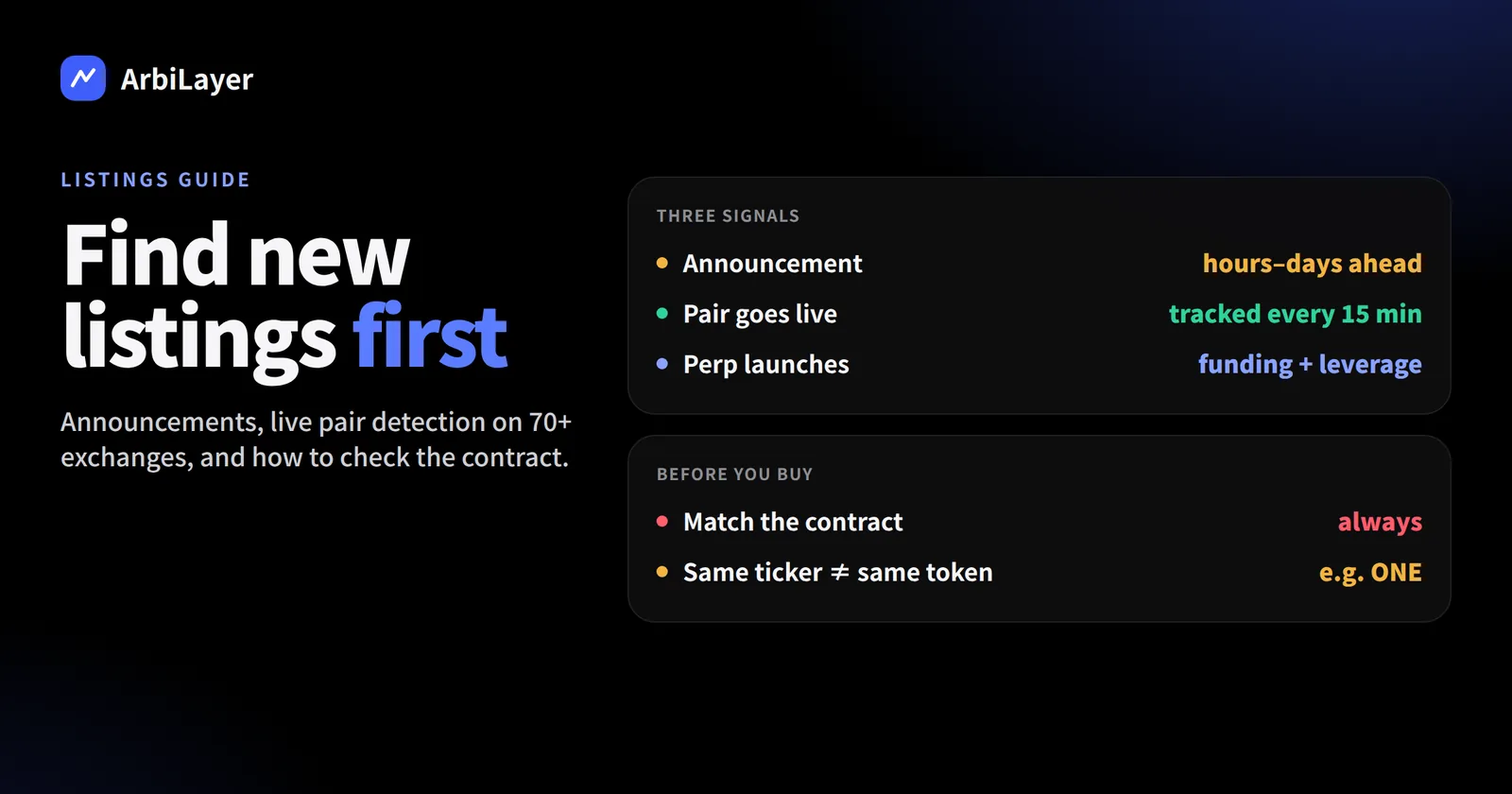
New listings are where crypto prices move the most. A coin that just started trading has no settled price, thin order books and often big gaps between exchanges. Traders who see a listing first get the best entries, and the best arbitrage. This guide explains where listings show up first, how ArbiLayer tracks them across 70+ exchanges, and how to make sure the token you are buying is the right one.
Three ways a listing becomes public
- The announcement. Exchanges publish "will list" posts, often hours or days before trading opens. Binance, OKX, Bybit, Bitget, KuCoin and Gate publish them on their announcement pages; MEXC keeps a listing calendar.
- The pair goes live. The trading pair appears in the exchange's market list. Many smaller exchanges list without much warning, so this is often the first real signal.
- The perpetual launches. Many coins get a perp on several exchanges within days of the spot listing, sometimes before it. A new perp brings leverage, funding, and its own price.
How ArbiLayer's listing tracker works
The new listings page combines all three signals:
- Live detection. Every 15 minutes the tracker reads the full market list of 70+ exchanges, spot and perpetual. A coin that was never seen before on an exchange becomes a listing event, with the time it started trading and its first price.
- Announcements. Listing posts from Binance, OKX, Bybit, Bitget, KuCoin, Gate and the MEXC calendar are collected every 10 minutes, with a countdown when the opening time is known.
- Where it trades now. Each listing shows every exchange that already trades the coin, with direct links to the pair.
Every listed coin gets its own page at /listings/coin/{ticker}, with the full timeline (which exchange listed it first, when the perps followed), the contract address and links to funding and arbitrage. You can also filter the listings page by exchange.
Which exchanges list first
Big exchanges list few coins and usually after they have traded elsewhere. The early listers are mid-size exchanges with a "list everything" strategy. You can see the current ranking, counted live from our tracker, on exchanges that list new coins first.
In our own study of MEXC vs Gate small-cap listings, MEXC and Gate were the most active small-cap listers, with clear differences in order-book depth after listing. Bitget, BingX, KCEX and Ourbit are also frequent early listers. Binance, OKX and Coinbase listings matter for a different reason: they bring the liquidity and the price jump, usually after the early exchanges.
Check the contract before you buy
A ticker is not an identity. Several unrelated tokens can share the same symbol, and scammers deploy copycat tokens with the name of a new listing on DEXs. Before you trade:
- Use the contract address from the exchange. Each exchange shows the deposit network and contract for the coin. ArbiLayer's listing page shows the verified contract when the coin can be identified safely; when a ticker is shared by several coins, it says so instead of guessing.
- Match the contract across exchanges. If two exchanges list the same ticker on different contracts, they are different tokens, and the "spread" between them is not arbitrage. The arbitrage scanner marks pairs with matching deposit contracts with a ✓.
- Compare the price. If one exchange's price is wildly different from the others, assume it is a different token until proven otherwise. We recently had to separate Harmony and ONEchain, two coins that both trade as ONE.
- On DEXs, trade only the contract address, never by searching the name.
What listing days look like
- Big spreads. Prices differ by several percent between exchanges in the first hours. The arbitrage scanner shows them, but check deposits and withdrawals: many exchanges keep deposits closed for a while after listing, so spot–spot arbitrage may not be possible.
- Extreme funding. New perps often start with strongly positive or negative funding. Watch it on the coin's funding page; it can make a hedge expensive or very profitable.
- Thin order books. Market orders move the price a lot. Use limit orders and small size.
- Fast reversals. Many listings spike in the first minutes and fade. Speed matters more than conviction.
A simple workflow
- Keep /listings open, filtered by the exchanges you use.
- When a coin appears, open its listing page and check the contract and where it trades.
- Check the price on every exchange and the funding on any new perp.
- Decide: trade the listing, trade the spread, or wait for the next exchange to list.
New listings are also where exchange sign-up bonuses pay off: most new-user futures bonuses are usable on these markets. See the current offers on exchange sign-up bonuses.
This guide is educational and is not investment advice. New listings are highly volatile and can lose most of their value quickly.
This article is for information only and is not investment advice.