How to Short Crypto on Spot and Futures, and What Delta-Neutral Means
Step-by-step: shorting a coin with perpetual futures or spot margin, the costs (fees, funding, borrow interest), liquidation risk, and how delta-neutral positions earn funding or spreads without betting on price.
 SOL
SOL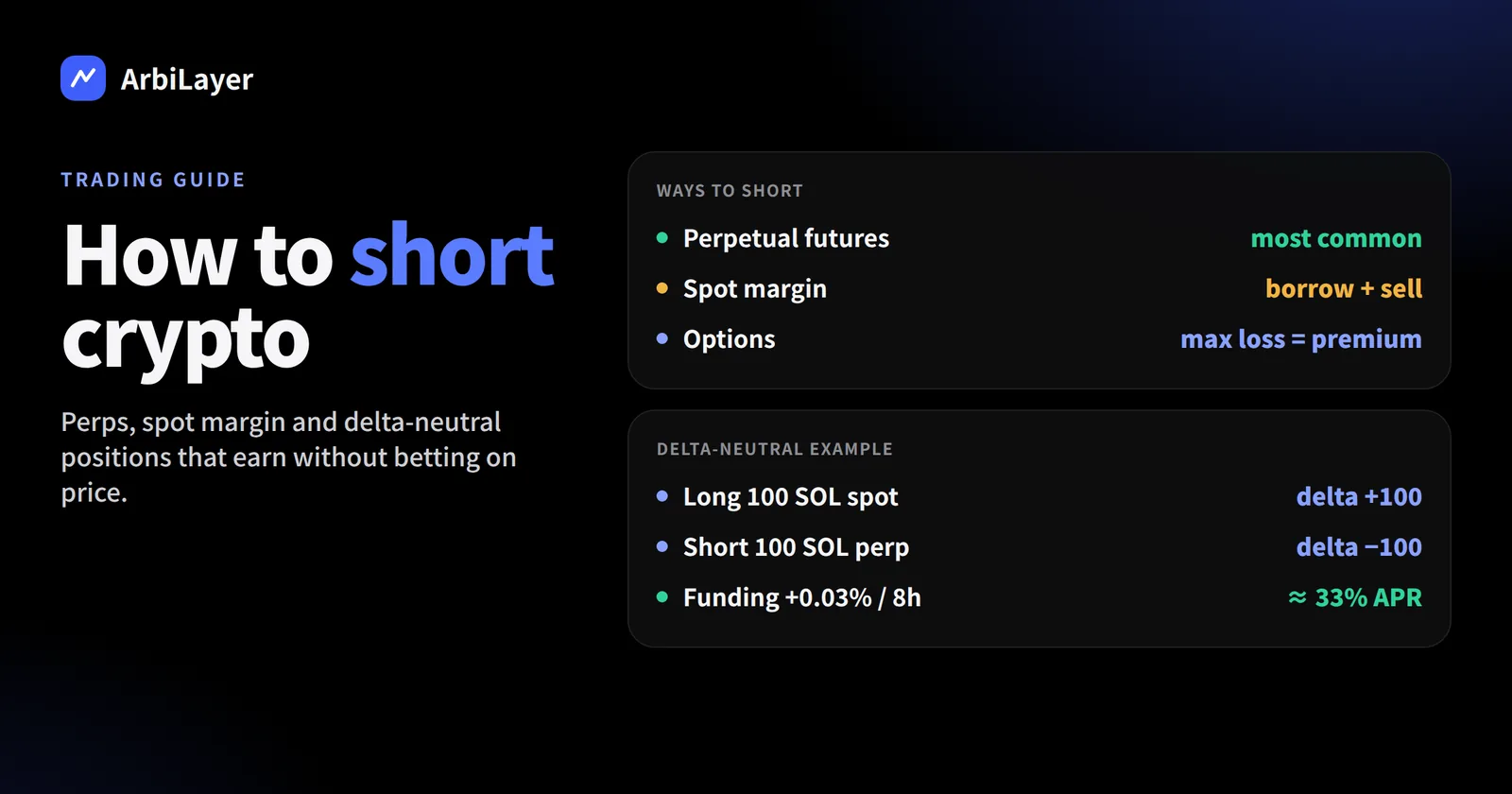
Shorting means making money when a price falls. In crypto you can do it in two main ways: with perpetual futures, which is how most traders short, or on spot by borrowing the coin on margin. A third idea, delta-neutral, uses a short to cancel out price risk entirely so you can earn funding or a spread instead of betting on direction. This guide covers all three, with the costs and risks of each.
What shorting means
When you buy a coin you profit if it goes up. When you short, you sell first and buy back later. If the price falls in between, you keep the difference. If it rises, you lose, and in theory the loss has no ceiling, because a price can rise without limit while it can only fall to zero.
How to short with perpetual futures
Perpetual futures (perps) are the simplest way to short. You don't need to own or borrow the coin: you just open a sell position.
- Pick an exchange that lists the perp. Most coins with any volume have USDT-margined perps on several exchanges. Our funding page shows where each coin trades.
- Deposit USDT (or USDC) as margin into your futures account.
- Choose leverage and margin mode. Isolated margin limits the loss to the margin you put on this position; cross margin uses your whole futures balance. Start low: 2x to 3x.
- Open a short (sell) for the size you want, with a stop-loss.
- Close by buying back the same size.
Costs to plan for:
- Trading fees on entry and exit. Compare them on lowest futures fees.
- Funding. When funding is positive, shorts receive it; when it is negative, shorts pay. A crowded short can bleed through negative funding even if the price stalls.
- Liquidation risk. A short is liquidated when the price rises far enough. At 5x leverage that is roughly a 19% rise; at 10x roughly 9 to 10%. See open interest, funding, ADL and liquidations explained.
How to short on spot (margin)
Some exchanges let you borrow a coin on margin, sell it, and buy it back later to repay the loan.
- Move collateral (usually USDT) to a margin account.
- Borrow the coin, for example 1,000 XYZ.
- Sell it at the current price.
- Later, buy 1,000 XYZ back and repay the loan plus interest.
Spot shorting is less common because:
- Borrow interest is charged hourly and can be high for small caps.
- Availability is limited: many coins can't be borrowed at all, or the lending pool runs dry exactly when everyone wants to short.
- It is usually more steps and less leverage than perps.
Its advantage is that there is no funding rate, and on some coins it is the only way to short.
Other ways to bet against a coin
- Sell what you hold. If you own the coin, selling is the simplest "short": you are out of the risk.
- Inverse or put options on the largest coins (BTC, ETH, SOL) on options venues. Your maximum loss is the premium you paid, but options are more complex to price.
What delta-neutral means
Delta is how much a position gains or loses when the price moves by $1. A spot holding of 10 SOL has a delta of +10. A short perp of 10 SOL has a delta of −10. Hold both, and your total delta is zero: if SOL rises $5, you make $50 on spot and lose $50 on the perp. Your position is delta-neutral.
Why do that? Because the price risk cancels, but other income does not:
- Funding. If funding is positive, your short perp receives funding every few hours while your spot leg just sits there. This is the classic cash-and-carry trade.
- Funding gaps between exchanges. Long a perp where funding is low or negative and short the same coin where funding is high. Both legs are perps, no coin moves between exchanges, and you collect the difference. Step-by-step in the funding rate arbitrage guide.
- Price spreads. Buy where the coin is cheap and short where it is expensive, then close both when the prices converge. Our arbitrage scanner lists these trades with fees, funding and depth, in Perp–Perp and Spot–Perp modes.
A worked example
SOL spot is $150 and the SOL perp on Exchange B pays +0.03% funding every 8 hours (about 0.09% a day). You buy 100 SOL on spot ($15,000) and short 100 SOL on the perp with $5,000 margin at 3x.
- Price risk: cancelled.
- Funding received: about $13.50 a day, roughly 33% a year on the $15,000 notional, while funding stays at that level.
- Costs: four taker trades (spot buy and sell, perp open and close) at around 0.05% to 0.1% each, so $30 to $60 in total. You break even on fees after a few days.
What can go wrong
- Funding flips negative. Then the short pays instead of receiving. Check 30-day funding history, not just today's rate.
- The short leg gets liquidated. If SOL jumps 30% your spot profit is on one account and your short loss on another; the short can be liquidated before you move collateral. Keep leverage low and margin topped up.
- Basis risk. The perp and spot prices can drift apart for a while.
- Exchange risk. Two venues means two counterparty risks. Withdrawals can be paused just when you need to rebalance.
Quick checklist before you short
- Check funding on the funding page: are you paying or receiving?
- Check the liquidation price and keep leverage low.
- Compare fees across exchanges.
- Set a stop-loss, or hedge if you can't watch the position.
- For delta-neutral trades, size both legs equally and watch funding daily.
This article is educational and is not investment advice. Shorting and leverage can lose more than your initial margin.
This article is for information only and is not investment advice.