Funding Rate Arbitrage: A Step-by-Step Guide
How funding rate arbitrage works: short where funding is high, long where it is low, collect the gap. The maths, a worked example, how to find trades with a live funding scanner, and the risks that matter.
 BTC
BTC SOL
SOL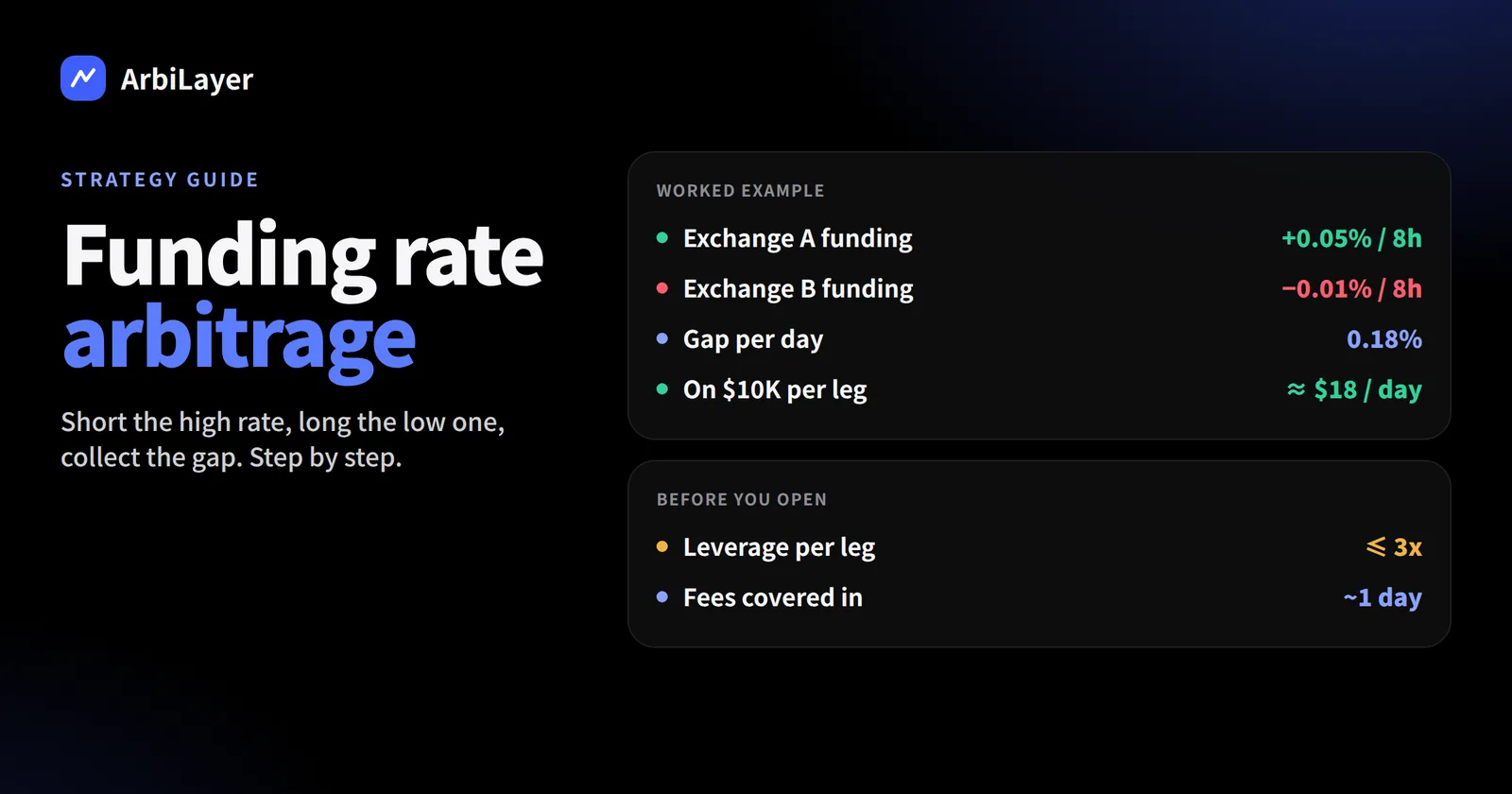
Funding rate arbitrage is one of the few crypto strategies that doesn't depend on guessing the direction of the price. You hold a long and a short on the same coin at the same time, so price moves cancel out, and you collect the difference in funding payments between two exchanges. This guide shows the whole process step by step, with the maths, and how to find the trades with ArbiLayer's scanner.
How it works
Every perpetual future pays funding between longs and shorts every 1 to 8 hours. The rate is set by each exchange separately, so the same coin can pay +0.05% per 8 hours on one exchange and −0.01% on another at the same moment. (If funding is new to you, start with open interest, funding, ADL and liquidations explained.)
The trade:
- Short the coin where funding is highest: positive funding means shorts receive it.
- Long the same coin, same size, where funding is lowest (ideally negative, so longs receive it too).
Your price exposure is zero. Each settlement you receive the gap between the two rates.
The maths on one example
Say XYZ pays +0.05% per 8h on Exchange A and −0.01% per 8h on Exchange B.
- Gap per 8 hours: 0.05% − (−0.01%) = 0.06%
- Per day (3 settlements): 0.18%
- Per year at that level: about 66% APR
With $10,000 on each leg:
- Funding income: about $18 a day
- Trading fees: four taker orders (open and close on both exchanges) at ~0.05% each = $20
- Break-even on fees: a little over one day, before the entry price spread
Real trades are rarely this clean: funding gaps shrink once people pile in, and rates change every period. Plan with the average of recent funding, not one reading.
Watch the intervals
Exchanges settle on different clocks. Hyperliquid and Lighter pay every hour; most centralised exchanges every 8 hours, some every 4 hours, and some switch a coin to a shorter interval when it is volatile. A rate of 0.01% every hour is 0.24% a day; 0.01% every 8 hours is 0.03% a day. ArbiLayer's funding page converts every rate to 24 hours and APR so the gap you see is real.
Step by step with ArbiLayer
1. Find the gap
Open the funding board and switch to Biggest gaps. Each row shows the coin, the venue with the highest and the lowest 24h funding, and the gap. Coins under $100K daily volume are already filtered out.
Click a coin to open its page, for example /funding/btc. You get every exchange's current rate, interval, countdown to the next payment, 24h rate and APR, plus the funding gap in the top cards.
2. Check the price spread
Funding is only half the trade. If the perp is $0.50 more expensive on the exchange where you short, that helps you; if it is cheaper, you start at a loss that funding has to earn back.
Open the coin's arbitrage page, for example /arbitrage/sol, in Perp–Perp mode. It lists every exchange pair with the price spread, the net spread after fees, Spread+F (spread plus the next funding payment), executable depth and Funding 30D: how much this pair's funding difference paid over the last 30 days. A pair that only paid well today is a gamble; one that paid steadily for 30 days is a strategy.
3. Check that you can actually trade it
- Depth. The Depth column shows how much size fits before the spread closes. Don't size bigger than that.
- Fees. Funding arbitrage is fee-sensitive. Compare taker and maker fees on lowest futures fees; using limit orders (maker) can halve the cost.
- Funding history. A rate that flips sign every few hours will eat your profit.
4. Open both legs
- Use the same size on both exchanges, in coin units, not dollars.
- Open them as close together in time as you can.
- Use low leverage (2x to 3x) and isolated margin on each leg, so a sharp move doesn't liquidate one side.
5. Manage the position
- Rebalance margin. If the price rises 20%, the short leg loses and the long leg gains, but on different exchanges. Move profit to the losing side before it gets close to liquidation.
- Track funding. Close when the gap shrinks below what your fees and spread need.
- Mind the clock. You only earn funding if you hold the position at the settlement time.
6. Close
Close both legs together, again same size. Your profit is the funding collected, plus or minus the change in the price spread, minus fees.
A cheaper variant: spot–perp (cash-and-carry)
If funding on one exchange is strongly positive, you don't need a second perp: buy the coin on spot and short the perp. Positive funding goes to your short, the spot leg can't be liquidated, and there is no funding to pay on the long side. The arbitrage scanner's Spot–Perp tab lists these trades. The trade-off is that the spot leg ties up the full notional.
Risks
- Funding changes. The gap can close or flip within hours, especially on small caps and new listings.
- Liquidation of one leg. The biggest real risk. Low leverage and active margin management prevent it.
- Price spread drift. The two perps can move apart before they converge.
- Exchange risk. Two counterparties, withdrawal pauses, and different liquidation engines. See why exchanges liquidate the same position at different prices.
- Fees eat small gaps. Below about 0.02% per 8h, after fees there is rarely anything left.
Checklist
- The gap is large on a 24h-normalised basis, and steady over recent periods.
- The price spread is neutral or in your favour.
- Depth covers your size on both exchanges.
- Fees are covered within a few days of funding.
- Leverage is 3x or less, with spare margin on both exchanges.
- You know which funding settlement you are holding for.
Find today's candidates on the funding gaps board and check the price side on the arbitrage scanner.
This guide is educational and is not investment advice. Leveraged positions can lose more than the margin posted.
This article is for information only and is not investment advice.