Why Two Exchanges Can Liquidate the Same Position at Different Prices
Mark price formulas, index constituents, maintenance margin tiers, funding and collateral rules are all set by each exchange — so the same leveraged position can be liquidated on one venue and survive on another. What that means for hedged and arbitrage trades.
 BTCUUSDE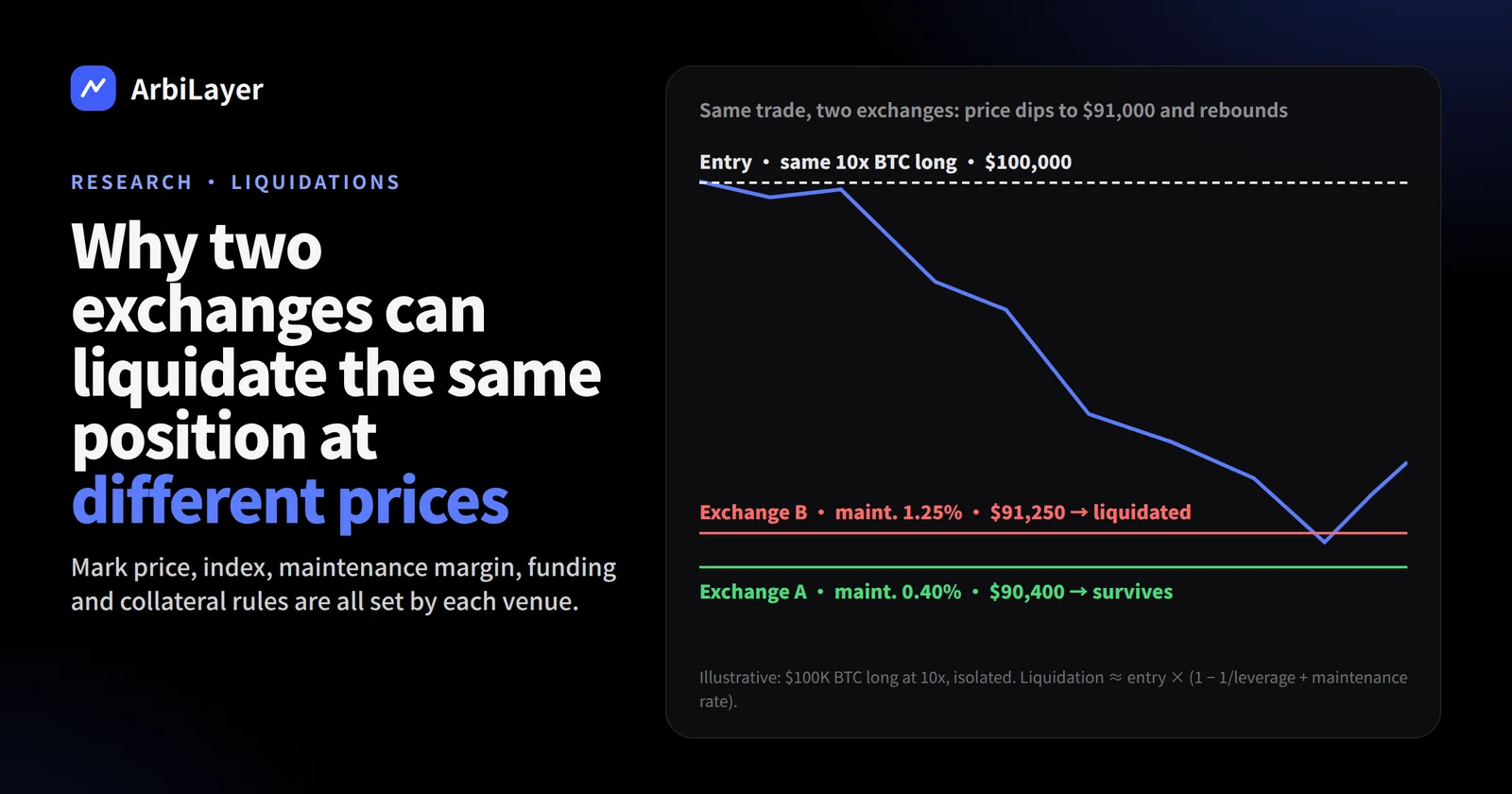
Open the same 10x BTC long on two exchanges, with the same entry and the same margin. Let the market drop. One position gets liquidated; the other survives — or both go, but at prices hundreds of dollars apart. Nothing is broken. Every exchange runs its own liquidation engine, and almost every input to it is set by the exchange itself.
For arbitrage traders this matters more than for anyone: a hedged position is two positions on two venues, and each one can be liquidated on its own terms, even when the trade as a whole is flat.
1. Liquidations use the mark price, and every venue builds its own
No major exchange liquidates on the last traded price. They use a mark price — an estimate of fair value designed to ignore wicks on their own order book. But each venue builds it differently.
Bybit takes the median of three numbers: the index price adjusted by the last funding rate and the time left to the next funding, the index plus a 2.5-minute moving average of the gap between its own mid price and the index, and its last traded price, according to its mark price documentation.
Hyperliquid starts from an oracle — a weighted median of prices on centralized exchanges that deliberately excludes Hyperliquid itself — and builds the mark from three inputs: the oracle plus a 150-second average of its own basis, the median of its best bid, best ask and last trade, and the mid prices of perpetuals on Binance, OKX, Bybit, Gate and MEXC, weighted 3, 2, 2, 1 and 1. Both update about every three seconds, per its documentation.
BitMEX marks to a fair price derived from its spot index and the funding basis, and reminds traders that this can differ from the price on the chart in thin or fast markets, per its support center.
Different formulas, different smoothing windows and different update speeds mean that in a fast move two marks for the same coin can sit a fraction of a percent apart for several seconds — enough to put one position over the line and not the other.
2. The index behind the mark is different too
The mark is built on an index: a basket of spot prices from selected exchanges. Each venue chooses its own constituents, weights them its own way and has its own rules for dropping a source that misbehaves.
When one spot exchange prints a wick, every derivatives venue that includes it in its index feels it, and every venue that does not stays calm. On a large coin the effect is small. On a mid-cap that trades meaningfully on only three or four spot venues, a single bad print can move one exchange's index by a percent or more while another's barely changes.
3. Maintenance margin decides where the line is
The liquidation price is the point where your remaining margin falls to the maintenance margin — a percentage of the position the exchange requires you to keep. Venues set this rate themselves, and it rises in tiers as the position grows.
For an isolated long, ignoring fees, the liquidation price is roughly:
Liquidation price ≈ entry × (1 − 1/leverage + maintenance margin rate)
Take one position — a $100,000 BTC long at $100,000 with 10x leverage — on three venues with different maintenance rates:
| Maintenance margin rate | Liquidation price | Distance from entry |
|---|---|---|
| 0.40% | $90,400 | −9.60% |
| 0.50% | $90,500 | −9.50% |
| 1.25% | $91,250 | −8.75% |
The rates here are illustrative; every venue publishes its own tier table per coin. The point is the spread: the same trade can be liquidated $850 earlier on one venue than another. Larger positions climb the tiers faster on some exchanges than on others, so the gap widens with size — and on small caps, where maintenance rates are higher, it widens again.
4. Fees and funding eat the margin at different speeds
Liquidation prices are not fixed. On an isolated position, every funding payment is taken from — or added to — the margin, and that moves the liquidation price.
If you are long on a venue with high positive funding, your liquidation price creeps up every settlement. Hold the same long on a venue with negative funding and it creeps down. Over a week of elevated funding, two identical positions can drift apart by much more than the maintenance-margin difference. Many venues also reserve trading and liquidation fees inside the margin calculation, which moves the trigger slightly closer. Compare live rates on the ArbiLayer funding page.
5. Your collateral can be priced differently
On cross-margin and unified accounts, the question is not only where the position is, but what your collateral is worth — and each venue decides that.
The clearest case is the crash of October 10, 2025. During roughly 40 minutes, Ethena's USDe traded as low as $0.65 on Binance, wBETH near $430 and BNSOL near $34.90, while all three stayed close to their normal value on other venues, according to Galaxy Research. Binance valued them from its own order books, so accounts using them as collateral lost margin they would not have lost elsewhere, and positions were liquidated. Binance compensated affected users — reports put the total at over $283 million, per CoinGecko — and moved to redemption-rate pricing for these assets, according to Yahoo Finance.
The same USDe-backed position on another exchange would have been untouched.
6. What happens after the trigger differs as well
Two venues can trigger at the same price and still leave you with different results:
- Partial or full liquidation. Some engines close only enough to restore margin; others close everything.
- Insurance funds. When a liquidation fills below the bankruptcy price, the venue's insurance fund absorbs the loss — if it is large enough.
- Auto-deleveraging (ADL). When the insurance fund cannot cover a loss, profitable positions on the other side are closed by force. On October 10, ADL hit traders on several venues while liquidations passed $19 billion in a day, per Galaxy Research. A trader who was perfectly hedged could find the winning leg closed by ADL on one exchange and the losing leg still open on the other.
7. Bad prints can reach one venue and not another
Oracles are only as good as their sources. When a venue's oracle takes in a broken price, its mark follows and liquidations follow the mark. We covered one example — the July 2026 SK Hynix print that liquidated about $60 million of longs on a single venue — in What Happens to Crypto Stock Futures When Nasdaq Closes?.
Summary: why the same position dies at different prices
| Cause | What differs between venues |
|---|---|
| Mark price | Formula, smoothing window, update speed |
| Index | Constituent exchanges, weights, outlier rules |
| Maintenance margin | Base rate and tier steps by position size |
| Funding and fees | Rate and interval; how fees are reserved in margin |
| Collateral | How non-USDT collateral is valued |
| Liquidation engine | Partial vs full, insurance fund, ADL |
What this means for arbitrage and hedged trades
A cross-exchange arbitrage is a long on one venue and a short on another. Price risk cancels out; liquidation risk does not. Each leg is margined alone, by its own venue's rules. If the price runs hard against one leg, that leg can be liquidated while the other is sitting on an equal profit you cannot use.
- Calculate the liquidation price on each venue separately. Use the venue's own maintenance rate for your size, not a generic calculator.
- Keep leverage well below the maximum. The difference between venues is a fraction of a percent at 3x and several percent near the limit.
- Use isolated margin per leg, and top up the losing leg. Moving profit from the winning venue takes time; keep a buffer in place before you need it.
- Watch funding on both legs. It moves each liquidation price every settlement.
- Be careful with exotic collateral. Wrapped tokens and yield-bearing stablecoins are valued by each venue's own rules.
- Check the market quality first. Spreads that look wide on thin venues often come with thin books and nervous marks — the ArbiLayer arbitrage scanner shows depth and funding for both legs next to every spread.
This article is for information only and is not investment advice. Leveraged perpetuals can lose more than the margin posted.
This article is for information only and is not investment advice.