What Happens to Crypto Stock Futures When Nasdaq Closes?
Stock perps trade 24/7, but US stocks have no price for 48 hours every weekend. How Bybit, Bitget, BitMEX, Deribit, edgeX, MEXC and Hyperliquid's trade.xyz price the dark hours, why funding keeps running, and why the reopen is the riskiest minute.
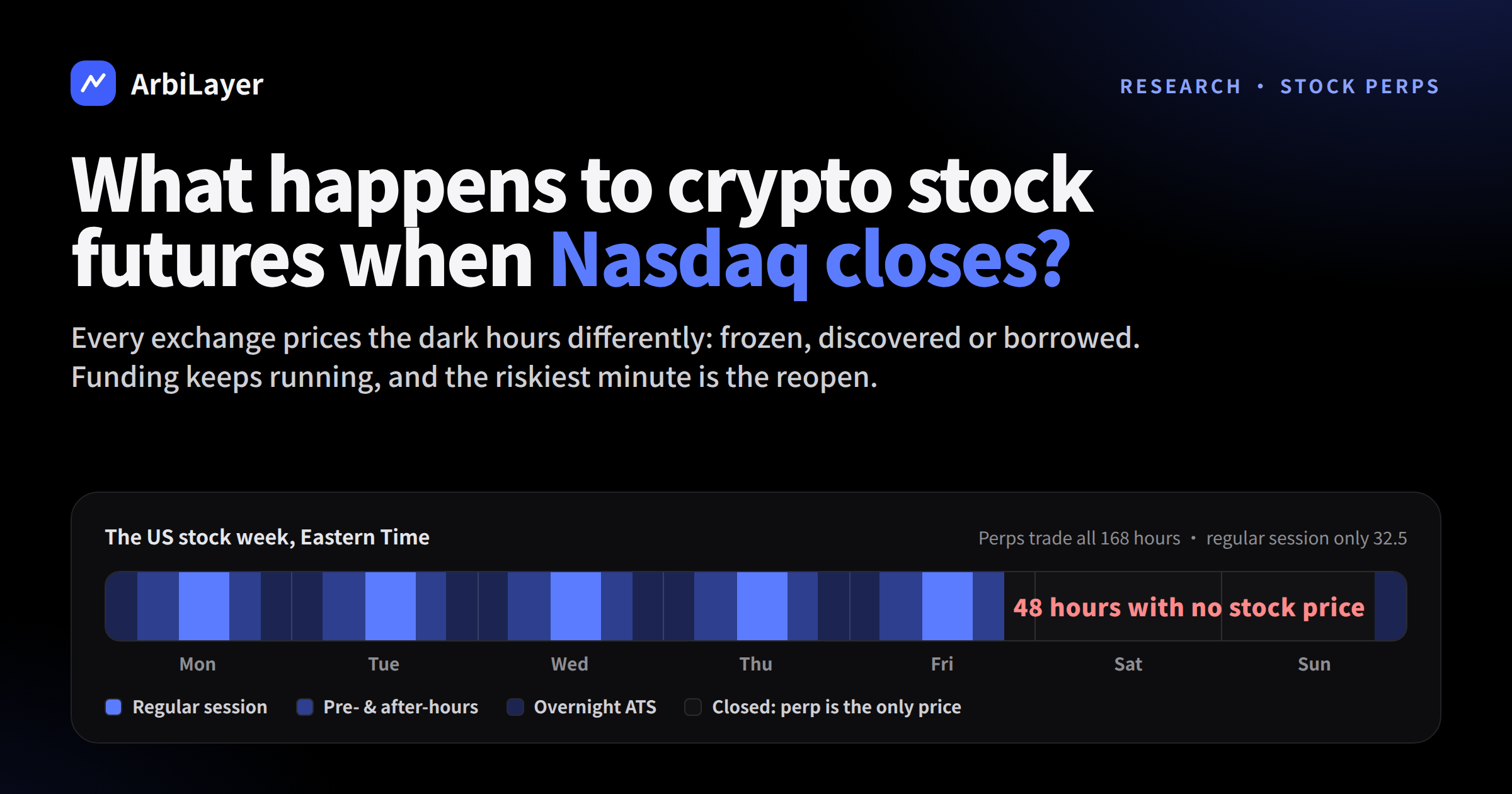
Stock perpetuals on crypto exchanges never close. On most venues, Nvidia, Tesla or the Nasdaq-100 trade at 3 a.m. on a Sunday just as they do at the New York open — on Binance, Bybit, MEXC, Hyperliquid and, for a growing list of contracts, Bitget. The stock market does close — and for most of the week there is no live Nasdaq price for the contract to follow.
So what is your stock perp actually tracking at night and on weekends? The short answer: something different on every exchange. Some freeze the reference price and fence the contract inside a band, some let the order book discover a new price, some switch to tokenized-stock feeds. Funding keeps running either way, and the riskiest moment is not the weekend itself but the minute real prices come back.
How long the market is really closed
US stocks now trade almost around the clock on weekdays, but the price a perp can lean on changes through the day.
| Session (Eastern Time) | Hours | What the perp can reference |
|---|---|---|
| Regular, Mon–Fri | 9:30 a.m.–4:00 p.m. | Live exchange prices |
| Pre-market and after-hours, Mon–Fri | 4:00–9:30 a.m., 4:00–8:00 p.m. | Live, but thin extended-hours prices |
| Overnight, Sun–Thu | 8:00 p.m.–4:00 a.m. | Alternative trading systems such as Blue Ocean ATS |
| Weekend | Fri 8:00 p.m.–Sun 8:00 p.m. | Nothing |
| US market holidays | All day | Nothing |
The regular session covers just 32.5 of the week's 168 hours — under a fifth. With extended and overnight trading a stock has some external price for about 120 hours a week. That still leaves a 48-hour dark window every weekend — 29% of the week — plus every US market holiday, when the perp is the only place on earth where the stock trades. The next long one is Thanksgiving on November 26.
Three ways exchanges price the dark hours
No two venues do this the same way, but the approaches fall into three groups.
1. Freeze the reference, fence the price. The index stops at the last real price and the contract is held inside a band around it.
- Bybit may drop stale components — such as US equity prices from Pyth — out of its index while markets are closed, and caps how far the mark price can move from the index: ±5% for stocks, ±3% for ETFs and commodities, according to its TradFi perpetual rules.
- edgeX anchors everything to the last closing index price. Buy orders cannot go above that price × (1 + 1/max leverage), sell orders not below × (1 − 1/max leverage) — ±10% on a 10x contract. Market orders are rejected, only limit orders inside the band are accepted, and the mark price may move at most 0.5% every three seconds, per its documentation.
- MEXC splits the week into regular and low-liquidity periods and warns that in low-liquidity periods "index prices may pause" and orders, including TP/SL, may not be filled, according to its stock futures guide.
2. Let the order book discover the price. The reference price keeps moving, driven by trading on the venue itself, inside safety limits.
- trade.xyz on Hyperliquid switches its oracle to an internal mode when no external price exists: it moves with a 30-minute exponential moving average of order-book pressure, each update is clamped to about 9.5%, and the mark price may only travel ±(1/max leverage) from a reference — ±5% at 20x — before the reference re-anchors, typically once or twice per direction. When an external price returns, the oracle snaps back to it on the next tick, per the trade.xyz documentation.
- Deribit builds an internal index from a one-hour EMA of its own mark price plus tokenized-stock or external perp prices, keeps the mark within ±7.5% of that index, and on Sunday blends back into real prices over a 10-minute bridge. It reserves the right to switch a market to reduce-only, cancel orders or halt trading when discovery breaks down, per its RWA perpetual rules.
3. Borrow another price. The index switches to whatever still trades.
- BitMEX references tokenized stock prices on other exchanges outside US hours, falls back to the median of bid, ask and last price on its own book if those go stale, and applies a 2% hourly price band, according to its equity perps launch post.
- Bitget pulls quotes from Pyth and dxFeed and applies EMA smoothing to the mark price outside trading hours "to reduce the impact of abnormal volatility", per its TradFi overview.
| Venue | Reference when Nasdaq is closed | How far the price can move |
|---|---|---|
| Bybit | Index without stale components | Mark within ±5% of index (stocks), ±3% (ETFs) |
| edgeX | Last closing index price | Orders within ±(1/max leverage); limit orders only |
| trade.xyz (Hyperliquid) | Internal oracle from order-book pressure | ±(1/max leverage) per discovery bound, re-anchors |
| Deribit | Internal index: EMA of mark + tokenized feeds | Mark within ±7.5% of index |
| BitMEX | Tokenized stock prices, then own order book | 2% hourly band |
| Bitget | Pyth and dxFeed, EMA-smoothed mark | Not specified |
| MEXC | Index may pause in low-liquidity periods | Not specified |
The practical consequence: the same stock can legitimately trade at different prices on different exchanges over a weekend. One venue is pinned near Friday's close, another has drifted with its own order flow, a third follows a tokenized token. Those gaps are real and tradable — and they close abruptly on Sunday night.
Funding never stops
Markets close; funding does not. BitMEX settles every eight hours "regardless of US equity trading hours", Bitget every four or eight hours, and Hyperliquid's builder markets keep accruing hourly funding through the weekend.
When the index is frozen at Friday's close and the perp trades above it, longs pay the whole gap as funding until Monday. A weekend of bullish positioning on a stock perp can therefore cost several settlements of elevated funding, even if the stock opens flat. Equity perps already carry richer funding than crypto: median equity funding has run around 13.9% a year against 3.9% for bitcoin, according to Ethena data cited by FXStreet. Check the live rate on the ArbiLayer funding page before carrying a position into Saturday.
Does the weekend price predict Monday?
Not yet. Blockworks Research tested 146 weekend samples across 23 Hyperliquid equity markets and found that the pre-open mid was closer to the actual open only 50.7% of the time, with a median improvement of about 0.4 basis points — "effectively no signal". Friday's close was the better predictor, according to its report.
The weekend market is also smaller and more retail. Weekend volume ran at about 31% of weekday levels and the median trade shrank from $1,245 to $196. Spreads were tight — 0.93 bps on weekends — but tight spreads on small size do not make a price meaningful.
In other words, a weekend move on a stock perp tells you how perp traders are positioned, not where the stock will open.
The dangerous minute: when real prices return
Every closed-market mechanism has to hand back control to a real price at some point, and that hand-off is where accidents happen.
The clearest example this year came from Korea. On July 28, 2026, a single SK Hynix share printed about 30% below the previous close at the 8:00 a.m. opening of the NextTrade pre-market. The print reached the xyz:SKHYNIX perpetual on Hyperliquid within minutes, the mark price fell 18.7% at once, and about $60 million of long positions — roughly 960 accounts — were liquidated, according to Galaxy Research. trade.xyz later reimbursed the losses as a one-time decision.
The same risk exists at every US reopen: Sunday 8 p.m. ET when overnight trading resumes, 4 a.m. for pre-market and 9:30 a.m. for the open. Bands that held the perp near Friday's close release it, internal oracles snap to the external price, and stop-losses that sat safely inside the band can fill far beyond it.
A checklist for trading stock perps off-hours
- Read your venue's closed-market rules. Know whether the price is frozen, discovered or borrowed, and how wide the band is.
- Size for the gap, not the band. A ±5% band protects the venue over the weekend; it does not stop the stock from opening 10% away on Monday.
- Use limit orders. Some venues reject market orders while closed, and the ones that accept them fill against thin books.
- Watch funding before the weekend. A frozen index plus a bullish crowd means paying funding on the gap for 48 hours.
- Don't read the weekend price as a forecast. The best available evidence says it has no edge over Friday's close.
- Be flat or small at reopen. The hand-off to real prices — Sunday night, pre-market and the 9:30 open — is when stops slip and liquidations cluster.
- Compare venues. Different closed-market methods create real weekend price gaps between exchanges; the ArbiLayer arbitrage scanner shows the same stock perp across venues side by side.
This article is for information only and is not investment advice. Leveraged perpetuals can lose more than the margin posted.
This article is for information only and is not investment advice.