TradFi in Crypto: Stock Perps, Tokenized Stocks and What You Really Own
Stocks, ETFs and commodities now trade 24/7 on crypto exchanges as perpetual futures and tokenized stocks. How they differ from real shares — ownership, dividends, voting, funding, off-hours pricing — and what to check when a new TradFi listing appears.
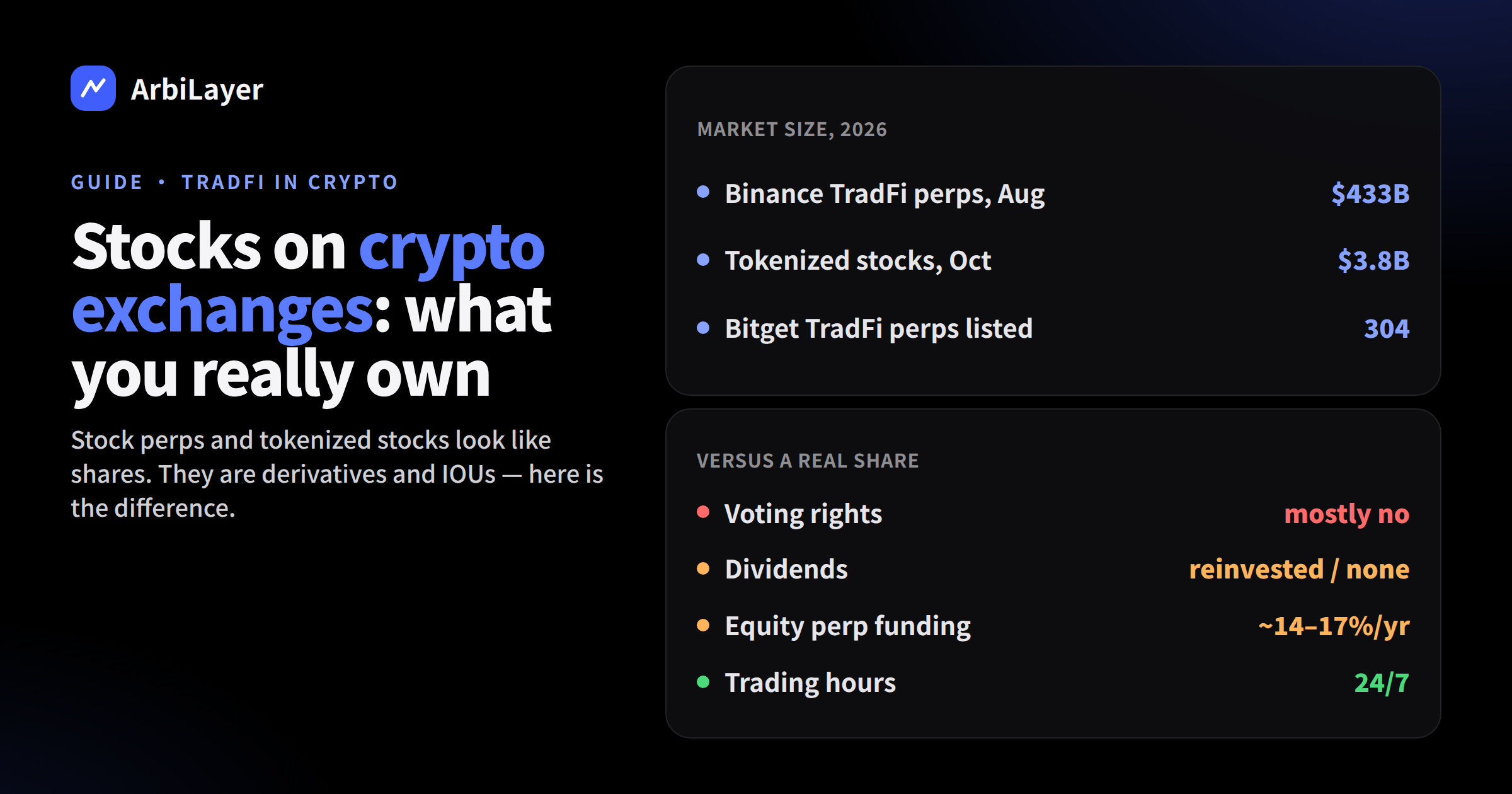
Nvidia, Tesla, gold, silver and the Nasdaq-100 now trade on crypto exchanges next to Bitcoin — around the clock, with stablecoin margin and leverage. In August 2026 Binance alone did $433.4 billion of volume in TradFi perpetuals, up from $29.5 billion in January, according to The Block. New stock and commodity contracts appear almost every day.
They look like stocks and move with stocks. They are not stocks. This guide explains the two main forms, how they differ from owning a share, and what to check when a new TradFi listing appears.
Two ways TradFi comes to crypto
1. Perpetual futures on stocks, ETFs and commodities
A stock perp is a derivative that tracks the price of a share, an ETF or a commodity. You never own the asset; you hold a leveraged long or short position margined in USDT or USDC, and funding payments keep the contract close to the underlying price.
Approximate counts of TradFi perpetuals by venue on September 1, 2026, per tv-hub:
| Venue | TradFi perps |
|---|---|
| Bitget | 304 |
| Hyperliquid (HIP-3 markets) | ~246 |
| Bybit | 224 |
| Binance | 180 |
| OKX | 168 |
| KuCoin | 139 |
| Coinbase International | 34 |
BingX says it lists more than 500, and MEXC and Gate run large stock-futures lineups of their own. Binance dominates volume: about 70% of TradFi-perp turnover at the end of August.
2. Tokenized stocks
A tokenized stock is a token, usually on Solana, Ethereum, BNB Chain or a dedicated chain, that tracks one share and is backed by real shares held by an issuer. The market reached a record of about $3.8 billion in October 2026, according to Crypto Briefing citing rwa.xyz.
The main issuers:
- xStocks (Backed, distributed by Kraken and others): 100+ assets, more than $30 billion traded by August 2026.
- Ondo Global Markets: a record $1.26 billion in value at the end of September 2026.
- Robinhood stock tokens: launched on Robinhood Chain on July 1, 2026 for users in 120+ countries.
How they differ from owning a real share
| Real share | Tokenized stock | Stock perp | |
|---|---|---|---|
| What you own | The share, in your name or your broker's | Usually a debt note from an issuer, backed by shares | A contract with the exchange |
| Dividends | Paid in cash | Usually reinvested in the token | None — reflected only in price and funding |
| Voting | Yes | Mostly no; some issuers now pass votes through | No |
| Hours | Exchange sessions | 24/5 or 24/7 | 24/7 |
| Leverage | Margin account | None on the token itself | Typically 10–100x, venue-dependent |
| Who can buy | Broker clients | Non-US, after KYC | Exchange users where allowed |
| Ongoing cost | None | Spread and issuer fees | Funding, often well above crypto |
Three differences matter most in practice.
Ownership. Kraken describes xStocks as "synthetic exposure" with no legal claim on the underlying shares, and Robinhood's tokens are debt securities with no legal or beneficial rights in the stock. You carry the issuer's risk on top of the company's.
Funding. Equity perps have been expensive to hold long. Ethena reported average equity-perp funding of about 14% a year on Hyperliquid and 17.5% on Binance, positive on 94–97% of days, against about 2% for Bitcoin, according to CoinDesk. A buy-and-hold position in a stock perp can lose double digits a year to funding alone.
Off-hours prices. When Nasdaq is closed, a perp has no live price to follow. Every venue fills the gap differently, and the reopen is the riskiest moment of the week — see What Happens to Crypto Stock Futures When Nasdaq Closes?.
What to check when a new TradFi listing appears
New stock and commodity contracts show up on the ArbiLayer new listings tracker as soon as they start trading, alongside every other new pair. Before trading one:
- Perp or token? Same ticker, completely different product. A perp has funding and liquidation; a token has issuer risk and redemption rules.
- What exactly is the underlying? Common stock, an ETF, a leveraged ETF (SOXL, TQQQ), an index or a pre-IPO company. Leveraged ETFs and pre-IPO markets behave very differently from plain shares.
- How the price is sourced. Which oracle, which session (regular, pre-market, overnight) and what happens on weekends. A single bad print reached the SK Hynix perp on Hyperliquid in July 2026 and liquidated about $57–59 million of positions, per CryptoPotato.
- Funding on day one. New listings often open with extreme funding. Compare it across venues on the funding page.
- Liquidity and spreads. Depth on a new stock perp can be thin, and spreads widen sharply when the underlying market is closed.
- Corporate actions. Splits and dividends are handled by each venue on its own terms: perps are halted and resized, tokens are adjusted with a multiplier. See our stock splits calendar.
- Who is allowed to trade. US persons are excluded from most tokenized stocks and most stock perps; several products also exclude the UK, Canada and others.
- Market cap figures on aggregators. A tokenized stock's "market cap" is the value of tokens in circulation — sometimes miscounted — not the company's value. Tesla's xStock showed about $57 million on one aggregator while Tesla is worth over a trillion, as Forklog noted. That is also why we exclude tokenized stocks from small-cap comparisons.
Where regulation stands
In the US, the SEC adopted a five-year conditional innovation exemption on September 17, 2026 for on-chain venues trading tokenized shares — but only for tokens that carry the same rights as the share, including dividends and voting, and companies can object to third parties tokenizing their stock, per CoinDesk. Synthetic exposure is not covered. In the EU, tokenized stocks remain financial instruments under MiFID II rather than MiCA, and the major issuers have published EU prospectuses.
The short version
TradFi in crypto gives 24/7 access, stablecoin settlement and leverage that brokers do not offer. In exchange you give up ownership rights, pay funding or issuer costs, and take on off-hours pricing and venue risk. Treat a stock perp as a leveraged derivative and a stock token as an issuer's IOU — not as the share itself.
This article is for information only and is not investment advice.
This article is for information only and is not investment advice.