What Is a Wrapped Token and Why Does It Exist?
A wrapped token represents another asset one-to-one so it can be used on another chain, in DeFi or under a different token standard. The three kinds of wrapping — contract, custodial and bridge — their risks, the biggest bridge losses, and how to check a wrapped token.
 ETH
ETH BTC
BTC SOL
SOL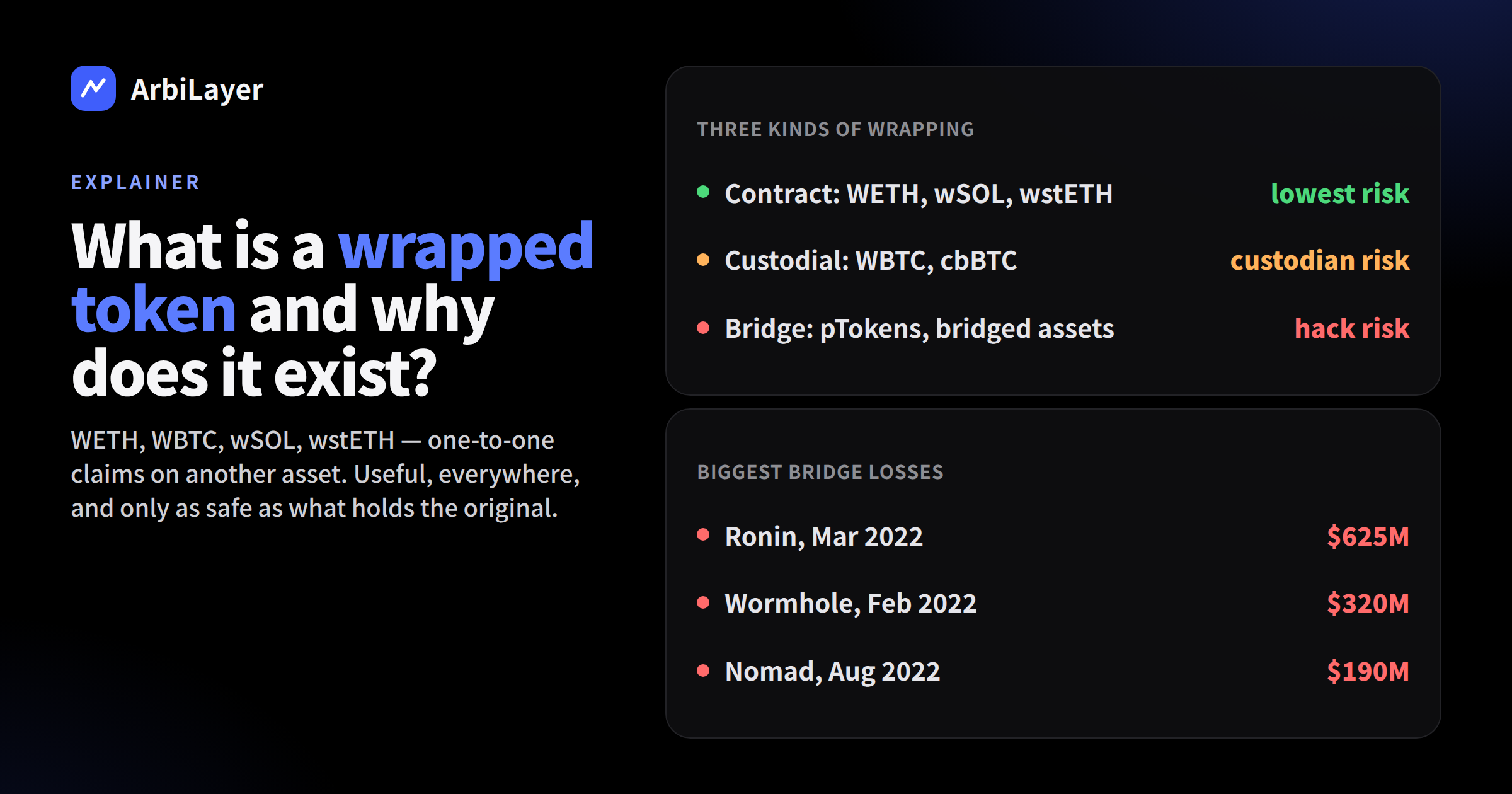
WETH, WBTC, wSOL, wstETH, cbBTC — crypto is full of tokens with a "w" in front. A wrapped token is a token that represents another asset one-to-one, so that the asset can be used somewhere it otherwise could not: on another blockchain, inside a DeFi protocol, or under a token standard it was never built for.
Wrapping is useful and everywhere. It is also where some of the largest losses in crypto history happened, because a wrapped token is only as good as whatever holds the original.
Why wrap a token at all
There are three main reasons.
1. To fit a token standard. Ether is the native coin of Ethereum, not an ERC-20 token, so smart contracts that expect ERC-20 cannot handle it directly. WETH solves this: you send ETH into the WETH contract and receive the same amount of WETH, an ERC-20 token you can swap, lend or provide as liquidity. The same idea gives you WBNB on BNB Chain and WPOL on Polygon. On Solana, wrapped SOL (wSOL) lets SOL be held in a token account so programs can treat it like any SPL token.
2. To move an asset to another chain. Bitcoin cannot run Ethereum smart contracts, so to use BTC in Ethereum DeFi someone has to hold real BTC and issue a token that represents it — WBTC, cbBTC and others. Bridges do the same between chains: they lock a token on chain A and mint a wrapped version on chain B.
3. To make a position easier to use. Liquid staking tokens can change their balance every day, which breaks many DeFi protocols. wstETH wraps Lido's stETH into a token with a fixed balance whose value rises instead, so it works as collateral almost everywhere.
The three kinds of wrapping
| Kind | Examples | Who holds the original | Main risk |
|---|---|---|---|
| Contract wrapping | WETH, WBNB, wSOL, wstETH | A smart contract, on the same chain | Smart contract bugs (low for old, battle-tested contracts) |
| Custodial wrapping | WBTC, cbBTC | A company or group of custodians | The custodian: solvency, honesty, freezes |
| Bridge wrapping | Bridged USDC (old), pTokens, many "Wrapped X" on other chains | A bridge contract or its validators | Bridge hacks and broken minting |
Contract wrapping is the safest: the original sits in a public contract and you can unwrap at any time, with no company involved. WETH has done this since 2017.
Custodial wrapping depends on people. WBTC's bitcoin is held by custodians, and in August 2024 BitGo moved custody to a joint venture involving BiT Global, a firm linked to Justin Sun. The change worried part of the market; Coinbase stopped supporting WBTC in December 2024 and promotes its own cbBTC. Neither token is "just bitcoin" — each is a claim on a custodian.
Bridge wrapping has failed the most. The wrapped token is only backed while the bridge's locked funds are intact and only the bridge can mint:
- Wormhole, February 2022: an attacker minted 120,000 wrapped ETH on Solana without depositing anything, about $320 million at the time.
- Ronin, March 2022: about $625 million drained from the bridge behind Axie Infinity after validator keys were compromised.
- Nomad, August 2022: about $190 million taken by hundreds of copycat addresses after a faulty update.
- pGALA, November 2022: an exposed admin key on a wrapped GALA contract led to billions of unbacked tokens and a $6.5 million arbitrage on an exchange that still accepted them — the full story is in our pGALA case study.
How to tell whether a wrapped token is safe
- Find out who holds the original. A contract you can read, a named custodian, or a bridge with its own validators. The more people involved, the more can go wrong.
- Check the backing. Good custodial tokens publish proof of reserves you can compare with the token supply. Bridges should hold at least as much as they have minted.
- Check redemption. Can you — or at least authorised merchants — always turn the wrapped token back into the original? WETH: anyone, instantly. WBTC and cbBTC: through approved parties.
- Use the official contract address. Many chains have several "wrapped" versions of the same asset from different bridges, often with the same ticker. They are not interchangeable, and one of them may be unbacked.
- Watch the price against the original. A wrapped token trading below its underlying is the market's warning that something may be wrong with the backing.
Wrapped tokens and exchanges
Exchanges list many assets on several deposit networks, and often several of those networks carry wrapped versions. When you deposit, the exchange credits the token it expects on that network. Problems start when an exchange credits a wrapped token that has lost its backing as if it were the original — exactly what turned GALA into two different tokens on Huobi in 2022.
For arbitrage traders this matters more than for anyone: a price gap between two exchanges can simply be the gap between the real asset and a broken wrapper. ArbiLayer's scanner compares deposit contracts on both sides of a trade and flags opportunities where the tokens do not match.
In short
Wrapping makes assets portable and usable — that is why WETH and wstETH are among the most used tokens in DeFi. But every wrapped token adds a layer of trust: in a contract, a custodian or a bridge. Know which layer you are trusting, use official addresses, and treat a wrapped token that trades below its original as a warning rather than a bargain.
This article is for information only and is not investment advice.
This article is for information only and is not investment advice.