VELO vs AERO Before the Merger: Is There a Conversion Arbitrage?
Until exchanges convert VELO into AERO in November, one VELO is a claim on about 0.044 AERO. When VELO trades below that, buying VELO and shorting AERO locks in the gap. How the trade works and the costs that usually eat the discount: an unfinished ratio, funding, frozen balances and thin books.
 AERO
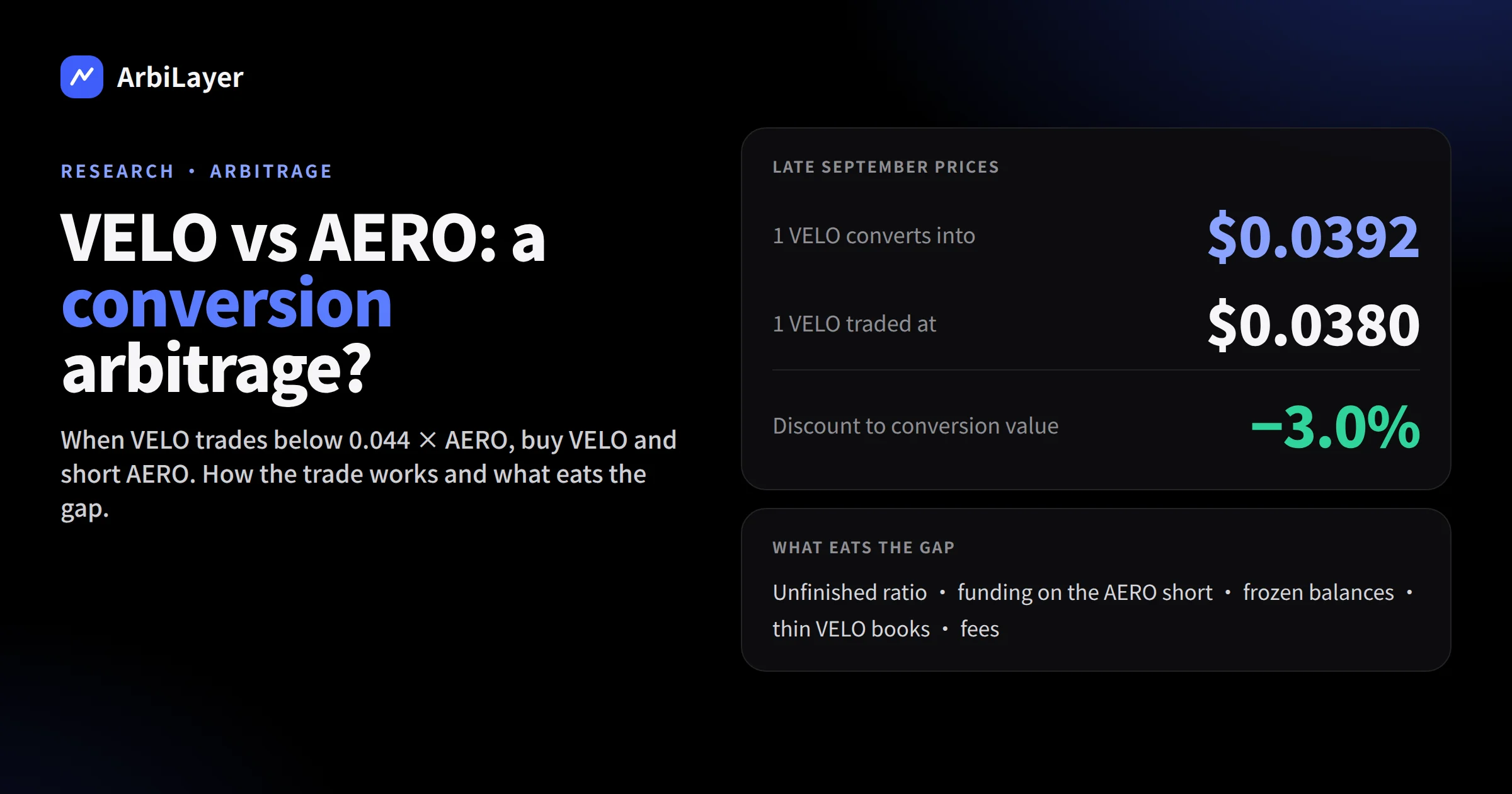
Until exchanges finish converting VELO into AERO in early November, one VELO is a claim on about 0.044 AERO. If the market prices VELO below that, it trades at a discount to its conversion value; above it, at a premium. In late September, after the merger date was set, AERO traded around $0.89 and VELO touched $0.038. At those prices one VELO converted into 0.044 × $0.89 = $0.0392 of AERO, so VELO sat about 3% below its conversion value.
A 3% gap on a deal with a known ratio looks like free money. It isn't, and the reasons are the same ones that make conversion arbitrage work at all.
The trade, step by step
- Buy VELO where it trades below 0.044 × AERO.
- Hedge: short AERO perpetuals for 0.044 AERO per VELO bought, so a move in AERO doesn't change the result.
- Convert: keep the VELO on an exchange that converts it (Coinbase: November 2–4) or upgrade it yourself through the portal after the October 21 launch.
- Close: once new AERO arrives, sell it or use it to close the short.
The profit is the discount at entry minus everything below.
What eats the discount
- The ratio isn't final. 0.044 is the announced approximation; the final rate depends on token supply at launch. A small change in the ratio moves the result by the same amount as the gap itself.
- Funding on the hedge. The AERO short pays or earns funding every interval for as long as you hold it, from the day you enter until the new AERO arrives. Compare rates across exchanges on the AERO funding page and short where funding is highest.
- Frozen balances. During an exchange's conversion window, old VELO can't be deposited, withdrawn or traded. Binance delists VELODROME spot pairs at 03:00 UTC on November 3 and pauses deposits and withdrawals 30 minutes later; Coinbase pauses both tokens for its November 2–4 window. If the conversion slips, the hedge keeps costing funding.
- Liquidity. VELO books are thin compared with AERO. Market-buying size moves the price and can wipe out a few percent on its own. Check order books before sizing.
- Fees. Spot buy, perp open and close, and possibly a withdrawal: about 0.2–0.4% in total on most exchanges.
- On-chain upgrade costs. The self-custody route needs a withdrawal to a wallet, gas on Optimism, and claiming rewards and clearing votes before upgrading. It also adds smart-contract and fake-portal risk.
- The wrong VELO. Binance lists Velodrome as VELODROME, and other tokens use the VELO ticker. A "discount" between two different tokens is not a discount.
When it can work
A gap is worth acting on when it is clearly larger than fees, slippage and the funding you expect to pay until conversion, and when your exchange has published its conversion dates. A gap of 1% with two weeks of funding ahead usually isn't. A sudden 5–10% discount, for example when holders rush to sell VELO before an exchange cut-off, can be.
The opposite case also exists: if VELO trades at a premium, holders do better selling VELO and buying AERO directly than waiting for the conversion.
How to check the gap yourself
- Take the AERO price and multiply it by 0.044: that is what one VELO converts into.
- Divide the VELO price by that number and subtract 1. A negative result is the discount, a positive one the premium.
- Repeat with a slightly different ratio, for example 0.042 and 0.046, to see how sensitive the trade is to the final rate.
For AERO prices on every exchange, see AERO arbitrage.
The timeline, the exchange schedules and what to do with locked tokens are in Aerodrome and Velodrome merge into Aero.
Not investment advice. Merger terms and exchange schedules can change; check official announcements before trading.
This article is for information only and is not investment advice.