Perp DEX Liquidity Report: Real Order Book Depth on Hyperliquid, edgeX, Aster, Lighter, Extended, dYdX, Paradex and Variational
We read the order books of eight perpetual DEXs in the same second and measured spreads, depth and the real cost of $100k and $1M orders. Hyperliquid holds by far the most depth, edgeX, Aster and Extended filled $1M BTC at CEX-like prices, and TVL turns out to say little about execution.
 BTC
BTC ETH
ETH SOL
SOL HYPE
HYPE ASTER
ASTER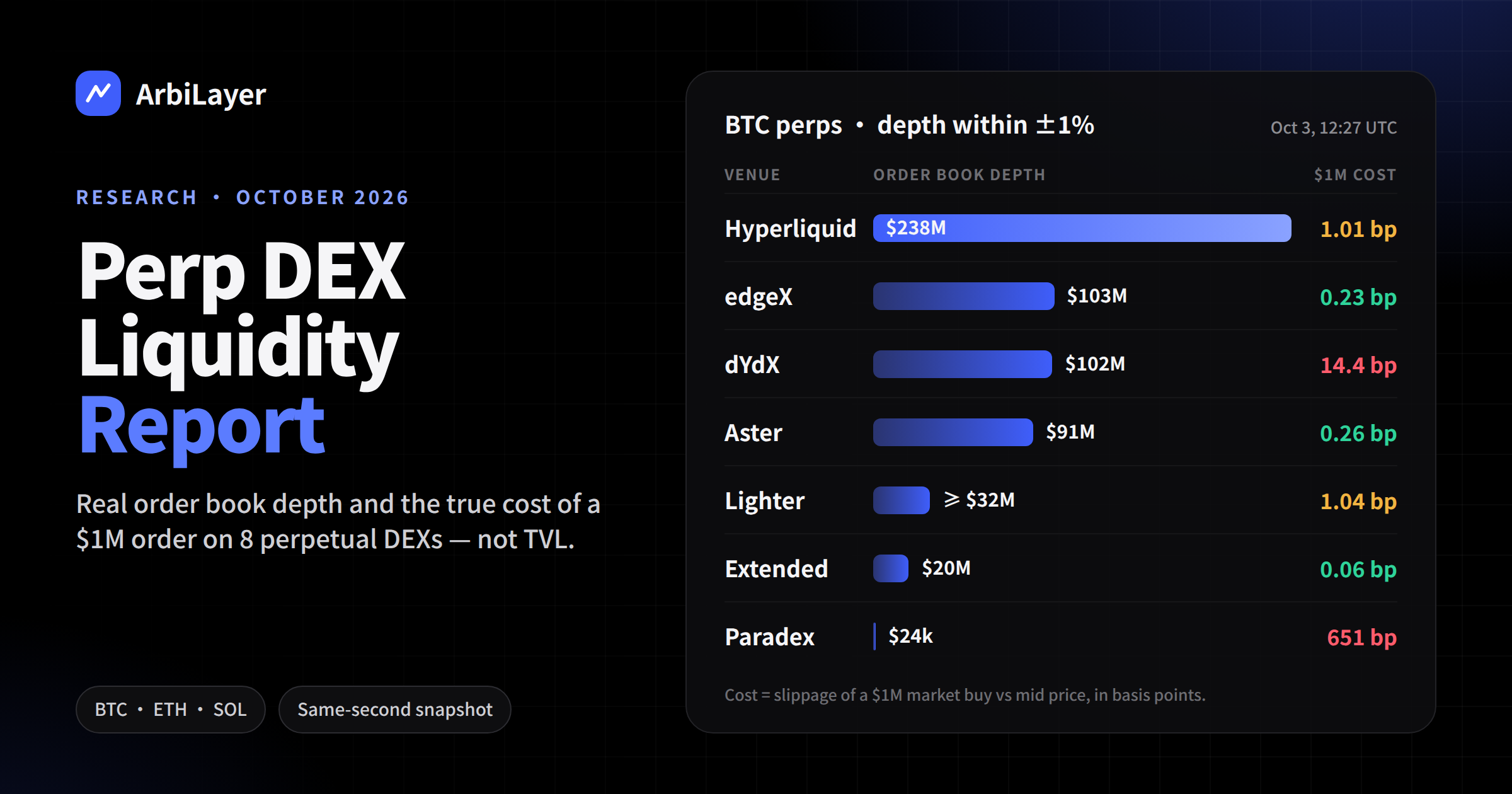
TVL is the number most perp DEX dashboards lead with, and it is the wrong number for a trader. Deposits sitting in a vault or a bridge contract tell you how much money trusts a protocol. They do not tell you what it costs to buy $1 million of BTC right now. That is set by the order book: how tight the spread is, how much size sits near the mid price, and how fast the price moves when you sweep it.
So we measured exactly that. ArbiLayer pulled the full public order books of eight perpetual DEXs — plus Binance and OKX as a reference — in the same second, and calculated what a real order would cost on each one.
How we measured
- Snapshot: October 3, 2026, 12:27:30 UTC. Every venue was read in parallel from one server, so all books are from the same second.
- Markets: BTC, ETH and SOL perpetuals.
- Spread: best ask minus best bid, in basis points of the mid price (1 bp = 0.01%).
- Depth ±0.1% / ±0.5% / ±1%: total USD value of bids and asks resting within that distance from the mid price.
- Slippage $100k / $1M: the average fill price of a market buy of that size versus the mid price, in bps. This is the number that decides whether a trade or an arbitrage leg is worth taking.
- Sources: each venue's own public order book API. No TVL, no reported volume, no estimates.
Venues in each table are ranked by the cost of a $1M order. Order books move every second, so treat this as a snapshot rather than a permanent ranking — we show below how much the top of the book moved in just fifteen minutes. You can check live prices for any pair on the arbitrage scanner at any time.
BTC perpetuals
| Venue | Spread | Depth ±0.1% | Depth ±0.5% | Depth ±1% | Slip $100k | Slip $1M |
|---|---|---|---|---|---|---|
| Extended | 0.12 bp | $7.4M | $20.3M | $20.4M | 0.06 bp | 0.06 bp |
| edgeX | 0.04 bp | $28.7M | $28.7M | $103M | 0.02 bp | 0.23 bp |
| Aster | 0.01 bp | $20.0M | $58.3M | $91.0M | 0.01 bp | 0.26 bp |
| Hyperliquid | 0.12 bp | ≈ $40.3M† | $145M | $238M | 0.06 bp | 1.01 bp |
| Lighter | 0.01 bp | $19.8M | ≥ $32.3M* | ≥ $32.3M* | 0.12 bp | 1.04 bp |
| dYdX | 0.47 bp | $0.31M | $43.2M | $102M | 6.01 bp | 14.4 bp |
| Paradex | 0.90 bp | $11k | $21k | $24k | 154 bp | 651 bp |
| Binance (CEX) | 0.01 bp | $58.9M | ≥ $88.6M* | ≥ $88.6M* | 0.01 bp | 0.15 bp |
| OKX (CEX) | 0.01 bp | ≥ $46.3M* | ≥ $46.3M* | ≥ $46.3M* | 0.01 bp | 0.01 bp |
*The public endpoint returns only the nearest orders (250 per side on Lighter, 1,000 levels on Binance, 400 on OKX), which did not reach that band. Depth beyond it exists but is not visible through the API, so the figure is a floor, not a total.
†Hyperliquid's full-precision book covers less than ±0.1% of the price, so this band is taken from its aggregated book and is approximate.
At the top of the book, the best DEXs now trade like a top CEX. Five DEXs quoted BTC at 0.12 bp or tighter, and three of them — Extended, edgeX and Aster — filled a $1M market buy for a quarter of a basis point or less, in line with Binance's 0.15 bp in the same second.
Hyperliquid still owns the deep book. $238M sits within 1% of the mid — more than twice any other DEX, and more than Binance's API even shows. A $1M order cost it about 1 bp because size is spread across many levels rather than stacked at the touch, but for orders of tens of millions and for liquidations, nothing on-chain comes close.
Aster looks the most like a centralized exchange. A 0.01 bp spread, $20M within 0.1%, $58M within 0.5% and $91M within 1% — a smooth, evenly filled book with no gaps.
edgeX has an unusual shape. About $29M is packed right at the touch, there is almost nothing between 0.1% and 0.5%, and then large evenly spaced walls hold $103M within 1%. Great for orders up to a few million; above that, the price jumps to the next wall.
Extended had the cheapest $1M fill of all, but it holds only about $20M within 1%, so the advantage disappears quickly as size grows.
ETH perpetuals
| Venue | Spread | Depth ±0.1% | Depth ±0.5% | Depth ±1% | Slip $100k | Slip $1M |
|---|---|---|---|---|---|---|
| Hyperliquid | 0.37 bp | —† | $47.5M | $134M | 0.19 bp | 0.30 bp |
| edgeX | 0.19 bp | $20.1M | $28.6M | $112M | 0.80 bp | 0.97 bp |
| Lighter | 0.67 bp | $14.1M | ≥ $39.6M* | ≥ $39.6M* | 0.64 bp | 1.17 bp |
| Extended | 0.37 bp | $4.4M | $12.0M | $13.4M | 0.19 bp | 1.24 bp |
| Aster | 0.04 bp | $7.3M | $38.1M | $92.6M | 0.27 bp | 2.14 bp |
| dYdX | 1.49 bp | $1.7M | $35.0M | $139M | 4.59 bp | 7.71 bp |
| Paradex | 3.24 bp | $5k | $17k | $17k | 177 bp | — |
| Binance (CEX) | 0.04 bp | $27.0M | ≥ $113M* | ≥ $113M* | 0.02 bp | 1.20 bp |
| OKX (CEX) | 0.04 bp | $29.2M | ≥ $48.5M* | ≥ $48.5M* | 0.02 bp | 0.02 bp |
†Hyperliquid's aggregated ETH book does not resolve the ±0.1% band, so that cell is left empty rather than estimated.
On ETH, Hyperliquid had the cheapest $1M fill of any DEX — 0.30 bp, ahead of Binance's 1.20 bp in the same second. edgeX, Lighter and Extended all filled $1M within about 1.2 bp.
Aster flips from first to fifth. It had the tightest ETH spread of any DEX, but only $7M rests within 0.1%, so a $1M order walked the book to 2.1 bp. Its $93M within 1% means that cost does not grow much further with size.
dYdX held the most ETH depth within 1% — $139M — but very little of it near the mid price, which is why a $100k market order still cost 4.6 bp (see below).
SOL perpetuals
| Venue | Spread | Depth ±0.1% | Depth ±0.5% | Depth ±1% | Slip $100k | Slip $1M |
|---|---|---|---|---|---|---|
| Extended | 0.84 bp | $2.7M | $4.6M | $4.9M | 0.42 bp | 1.98 bp |
| edgeX | 4.19 bp | $10.4M | $19.5M | $19.5M | 2.09 bp | 2.18 bp |
| Hyperliquid | 0.84 bp | $5.3M | $23.4M | $23.4M | 1.44 bp | 2.54 bp |
| Aster | 0.84 bp | $3.3M | $7.4M | $8.6M | 1.19 bp | 3.20 bp |
| Lighter | 0.17 bp | $2.3M | $13.3M | $20.6M | 1.13 bp | 5.54 bp |
| dYdX | 10.9 bp | $0.82M | $20.5M | $80.5M | 9.02 bp | 14.8 bp |
| Paradex | 109 bp | $0 | $0 | $0.5k | 315 bp | — |
| Binance (CEX) | 0.84 bp | $4.4M | $28.2M | $44.4M | 0.42 bp | 2.37 bp |
| OKX (CEX) | 0.84 bp | $3.6M | $22.6M | $28.9M | 0.42 bp | 2.63 bp |
On SOL, three DEXs beat both Binance and OKX on a $1M order. Extended (1.98 bp), edgeX (2.18 bp) and Hyperliquid (2.54 bp) were all on par with or cheaper than the two largest centralized exchanges in the same second.
edgeX is the odd one out. Its quoted spread was the widest of the top five at 4.2 bp, yet so much size sat just behind the best price — $10.4M within 0.1%, the most of any venue including the CEXs — that a $100k order and a $1M order cost almost the same. A small order pays for the spread; a large one barely moves the price.
Lighter had the tightest SOL spread at 0.17 bp, but its book thins out fast: a $1M order cost 5.5 bp.
The top of the book moves fast
We also read the books fifteen minutes earlier, at 12:15 UTC (edgeX at 12:25). The deep book barely changed — Hyperliquid's BTC depth within 1% moved from $247M to $238M. The cost of a $1M order changed a lot more:
| BTC, $1M market buy | 12:15 UTC | 12:27 UTC |
|---|---|---|
| Extended | 1.53 bp | 0.06 bp |
| edgeX | 0.17 bp | 0.23 bp |
| Hyperliquid | 0.73 bp | 1.01 bp |
| Lighter | 1.21 bp | 1.04 bp |
| dYdX | 12.1 bp | 14.4 bp |
Extended went from fourth to first in a quarter of an hour because a few market makers refreshed their quotes. That is why we rank venues by depth across several bands, not by a single slippage number, and why we will repeat these snapshots over time.
dYdX: deep, but not at the touch
dYdX shows an unusual shape. Within 0.1% of the mid there is very little size — $0.3M on BTC — yet within 1% it holds $80–139M, more than most other DEXs. Market makers on dYdX quote wide bands rather than tight ones. For a patient trader using limit orders that depth is real; for anyone who needs an instant fill, a $100k market order costs 5–9 bp, which wipes out most cross-exchange spreads.
Variational: quotes, not a book
Variational Omni works on request-for-quote: a market maker prices each order, so there is no public book to sum. Instead we read the quotes Variational publishes for fixed sizes in the same second:
| Market | Effective spread up to $100k | Effective spread at $1M |
|---|---|---|
| BTC | 1.0 bp | 1.7 bp |
| ETH | 1.0 bp | 3.7 bp |
| SOL | 2.4 bp | 12.1 bp |
These are round-trip spreads (ask minus bid), so a one-way market order pays roughly half. That makes Variational competitive for BTC and ETH up to about $1M, but noticeably more expensive on SOL at size. Variational also reports about $263M in TVL — a good example of why TVL says little about execution: what matters is the price the maker is willing to quote for your size.
Paradex
Paradex's public order book showed very little resting size — about $24k within 1% on BTC. Paradex routes a large share of its flow through RFQ and retail price improvement, which does not appear in the public book, so these numbers likely understate what a trader can actually fill. We list them as measured and will revisit once we can read executable quotes directly.
What this means for traders
- Rank venues by slippage at your size, not by TVL or volume. A venue with ten times the deposits can still cost more per trade.
- Up to $1M, the best DEXs match a top CEX. On BTC, Extended, edgeX and Aster filled $1M within 0.3 bp; on ETH, Hyperliquid beat Binance; on SOL, three DEXs beat both Binance and OKX. Fees, funding and withdrawal paths now matter more than book depth.
- Above a few million, Hyperliquid's depth is unmatched among DEXs, with edgeX, dYdX and Aster next on BTC within 1%.
- The cheapest venue changes by asset and by the minute. Aster led on BTC and came fifth on ETH; Extended moved from fourth to first in fifteen minutes. Check before every large order.
- For arbitrage, the thinner leg sets the size. A $100k market order on dYdX alone costs 5–9 bp, which eats a big part of a 20 bp cross-venue spread before fees.
ArbiLayer's arbitrage scanner and funding page show live spreads and funding for these venues, and each exchange page lists markets, fees and volume. We will repeat this report regularly with more venues and more assets.
Methodology note: depth is calculated from each venue's public order book at the snapshot time; hidden, iceberg and RFQ liquidity are not included. edgeX was read through its v2 API, since its older v1 order book endpoint returns an empty response. Figures are informational and not investment advice.
This article is for information only and is not investment advice.